Product architecture
Modular monolith
Catalogue, people, accounts, community, evidence, discovery and admin stay as explicit domain boundaries without premature service fragmentation.
Consumer product · Recommendation intelligence
A catalogue-first drama discovery and community product designed to keep factual identity, human opinion and machine-derived recommendation evidence separate enough to remain trustworthy.
The product idea
Most entertainment products collapse very different kinds of information into ratings, popularity or one ranking score. DramasPicks is built around a different separation: catalogue facts have one authority, authored human opinion has another, and machine interpretation must remain traceable back to evidence.
That makes it possible to support natural community conversation and explainable discovery without converting every review, click or dislike into opaque “engagement” truth.
Product model
What a title, person, credit or release fact actually is, with source and identity lineage.
What people wrote, felt, compared, dropped, rewatched, defended or disliked—preserved as authored context.
Versioned, provenance-backed interpretation that can remain UNKNOWN when the source does not support a confident claim.
Recommendation reasoning that combines constraints, caveats and taste context without pretending one universal score exists.
The layers can inform one another, but none is allowed to silently rewrite the others.
Implemented / accepted evidence
Product architecture
Catalogue, people, accounts, community, evidence, discovery and admin stay as explicit domain boundaries without premature service fragmentation.
Canonical identity
Provider IDs are mappings, not product identity. Canonical title/person UUIDs survive provider changes and keep community history attached.
Data operations
Imports move through normalization, review, promotion receipts, rehearsal and product-visible read checks rather than writing provider rows directly into product truth.
Database model
Canonical Beta and a separate persistent Owner Rehearsal database are kept distinct, while destructive verification stays disposable.
Community model
Reviews, thoughts, discussions, lists, recommendation requests and responses preserve authored meaning, privacy, spoilers and context.
Intelligence
Research findings and recommendation evidence live in a separate Intelligence Lab and cannot silently become product ranking truth.
Product proof
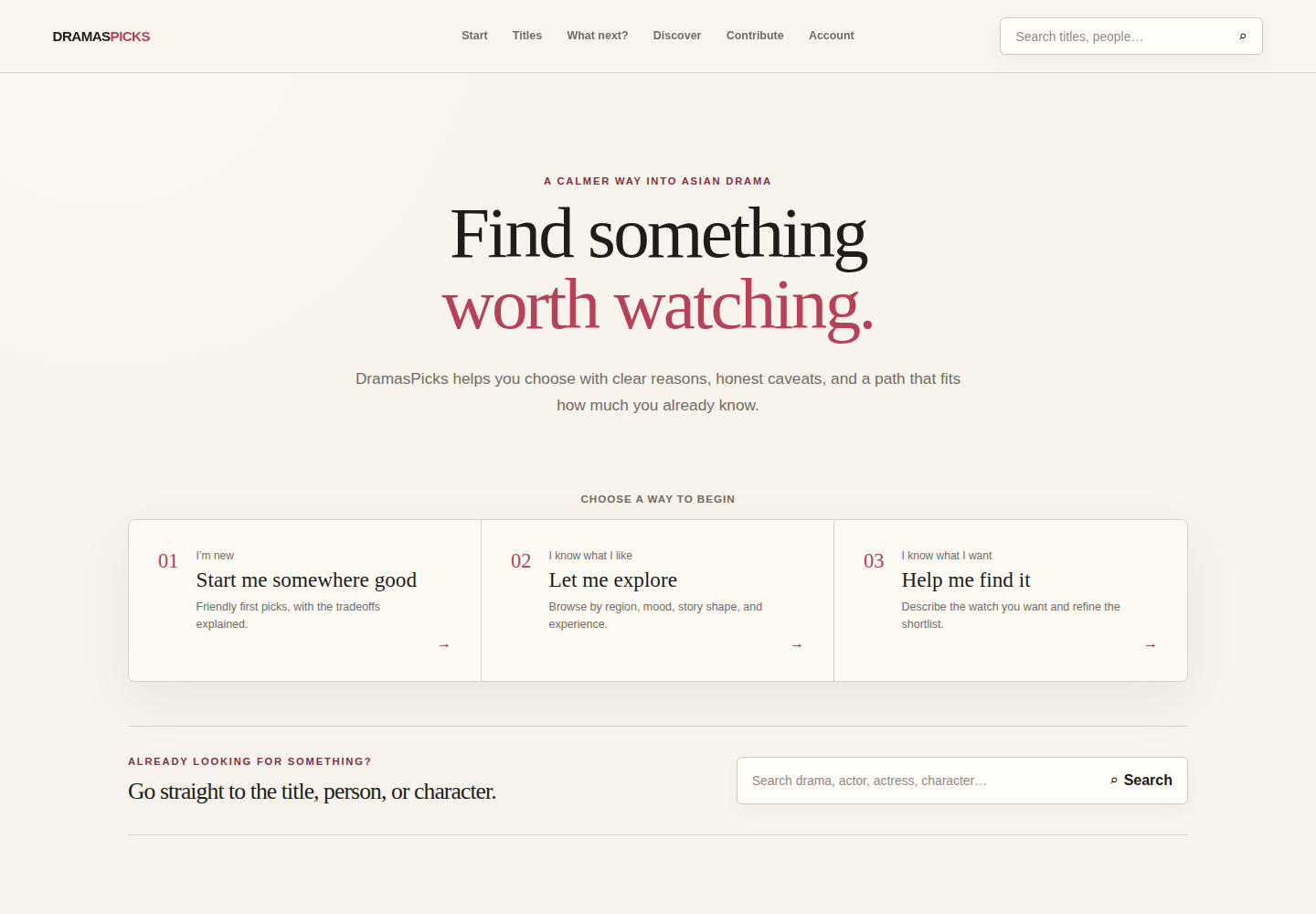
The screenshot below comes from the current DramasPicks repository visual-evidence suite. I selected the homepage because it demonstrates the product language and information architecture without relying on third-party poster or person imagery.
Catalogue engineering
Identity continuity
External IDs live as namespaced mappings. DramasPicks UUIDs remain the stable anchors for titles, people, authored content and evidence.
Current scale work
Repeated bounded cohorts have proven identity, publication and product read paths. Current catalogue work is moving toward deterministic, resumable selected-market acquisition with guarded promotion rather than one unbounded import.
Database safety
DramasPicks uses a canonical Beta PostgreSQL database plus a separate persistent Owner Rehearsal database for realistic browser/dev work. Automated migrations, destructive rebuilds and integration tests use disposable databases instead.
The point is not only protecting production-like data. It is preventing a developer or AI worker from accidentally treating a convenient local copy as canonical truth.
Recommendation intelligence
Research programme
Seven-community longitudinal fandom researchPublic fandom communities are used as research microscopes—not as a production corpus to bulk copy or train on without the right boundaries.
Lab owns
research · provenance · derived evidence · benchmarks · engine lineage
Product owns
catalogue truth · user data · product architecture · deployment · release
What I owned
Why this matters professionally
DramasPicks is where I learned to keep product convenience from overriding data truth. The hard parts are not just pages and components—they are identity, provenance, privacy, moderation, provider dependence, human meaning and how machine-derived intelligence is allowed to influence the experience.
Honest boundary
DramasPicks demonstrates full-stack product engineering, PostgreSQL/domain modelling, catalogue identity, auth/privacy, community architecture, controlled data operations and recommendation-research discipline.
It does not claim millions of users, a shipped Android application, a production fine-tuned recommendation model, or universal metadata rights. Mobile remains a separate pre-implementation direction and intelligence promotion remains gated.
Next product case study